

By Aidan Corcoran, Nature Recovery Ranger at Liverpool University Hospital Foundation Trust (LUHFT).
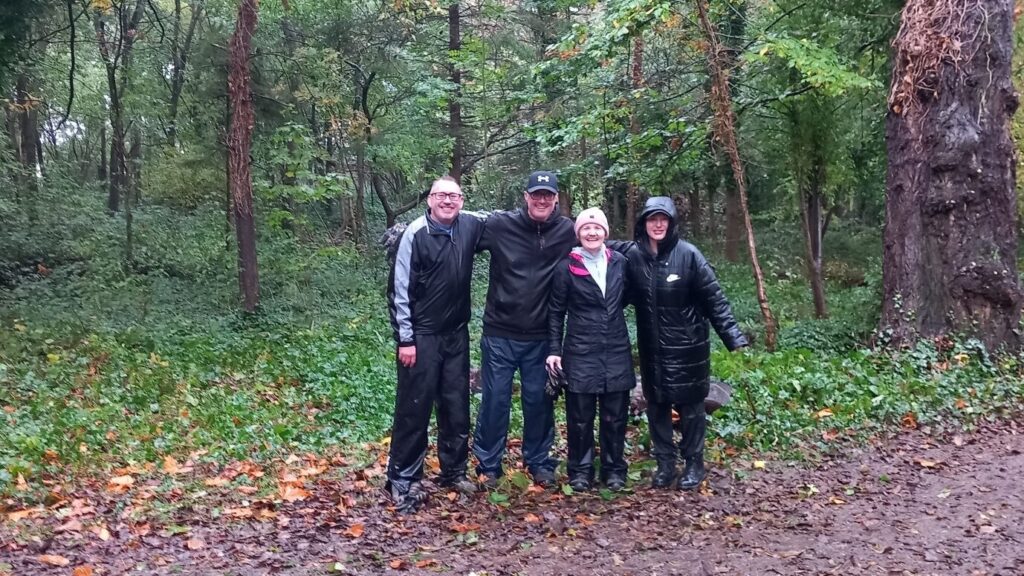
Back in October, four members of the Health and Safety Executive (HSE) came to volunteer in Bluebell Wood at Aintree Hospital, Liverpool. It was a week that had otherwise provided excellent weather for outdoor working, but this particular Tuesday turned out to be a sodden day of constant drizzle. We were occasionally blessed with periods of light, misty rain, but mostly it was thoroughly wet. Still, a fine day was had by all, punctuated with bellows of laughter, some good giggles, the odd anecdote and plenty of appreciation of nature’s profound beauty and presence. The photo below is from the end of the day, and the smiles are even broader and brighter than in the pre-event photo we took in the morning.
At the same time, a tremendous amount was achieved in the wood. As it was a wet day, I decided not to carry out any planting. Instead, pruning and chopping were the main activities. A good amount of bramble was suppressed and removed, and a great deal of side-pruning and crown-lifting of small trees was carried out, particularly along path edges to open up views through the wood. The day began with clearing the view of a small heritage feature in the wood, a little arched bridge over Fazakerley Brook. Small improvements like this can add moments of joy for passers-by and are of great value in managing the wood as a community wellbeing resource.
In addition to the aesthetic improvements, the work carried out has three significant functions. Firstly, it has a direct ecological purpose: disturbing the bramble lets sunlight warm and activate the seed bank in the soil, and creates space for (re)colonisation by other species to increase biodiversity. Secondly, clearing bramble from the edge of the brook makes it possible to remove debris from the watercourse, another necessary management activity for maintaining the health of the wood. Thirdly, opening up access to the brook edge will help with controlling invasive non-native species. The brook acts as a migration path through the area, and annual control of species such as Himalayan balsam forms part of the regular management of Bluebell Wood. Better access to the brook makes that control easier and more successful.
I would like to thank the volunteers personally, and on behalf of LUHFT and the Centre for Sustainable Healthcare (CSH). LUHFT, CSH and the local community are working together to improve the condition of Bluebell Wood, and the efforts of volunteers contribute greatly to what we can achieve.