

Larger-scale tree planting on healthcare sites
Bespoke planting projects on healthcare sites
NHS Forest offers more than just thematic tree bundles. For larger projects we can sometimes work with healthcare sites in England, Wales and Scotland to develop and supply unique location-specific tree mixes tailored to local conditions and the recipients’ objectives. At scale planting won’t be appropriate for every healthcare setting, but a larger number of trees can deliver significant benefits far beyond that of more fragmented tree cover where the capacity exists.
While we cannot commit to support every project, NHS Forest would welcome an initial conversation regarding any proposed planting comprising more than 250 trees in a single location on NHS land. Express your interest in fully funded trees today and we will be in touch to discuss how we might be able to support your project.
Important Update – Tree Applications
Thanks to the generosity of our sponsors and donors NHS Forest can offer trees to healthcare sites without charge. However, funding for the 2025–26 planting season is limited so trees will be allocated on a first-come, first-served basis.
We encourage applicants to submit and confirm tree requests as early as possible to avoid disappointment. Once the current funding comes to an end, application forms will remain open and we will update this page. Applications processed after the funding has been fully allocated will be carried over to next winter.
Thank you for your understanding.
Why should you plant more trees?
Healthcare settings vary in size and land use. If you are fortunate enough to have a large area of green space available that could accommodate more trees, planting with NHS Forest is a fantastic opportunity to make a huge environmental impact and benefit both your site and future generations.
- Plant to establish or augment therapeutic tree trails or woodland wellbeing walks around your site – tree lined paths are the perfect environment for patients and staff to reconnect with nature.
- More trees means more ecosystem services – trees can be used to absorb carbon, mitigate flooding and surface water runoff, shade and cool buildings and outdoor spaces, screen perimeters, and more.
- Trees can add ecological value and expand your site’s biodiversity. This may contribute to your baseline biodiversity which may be beneficial in relation to new Biodiversity Net Gain legislation.
- Why not plant trees in celebration or recognition? For example, having a tree for every staff member that works across your site, or to commemorate a significant anniversary.
What type of planting can NHS Forest support?
Typically NHS Forest is able to fund tree saplings – either 1–2-year-old forestry whips or small feathered trees – which is typical of and best suited to tree-planting projects and demonstrate good post-planting establishment rates in comparison with larger transplants.
Trees can be a selected from a broad range of species, including larger species such as oak and beech or ecological niche species suited to the unique qualities of your site. If a particular species is required (and aligns with our tree procurement policy) we will do our best to source it. Generally orders will also include appropriate planting accessories to ensure the trees survive and thrive.
Native saplings are extremely versatile and can be used to achieve a variety of planting outcomes, such as:
- Creating new areas of amenity woodland or smaller groves of trees
- Windbreaks or shelterbelts to provide protection from the elements
- Planting for wildlife – e.g. habitat corridors or pollinator islands
- Open-canopy parkland planting on areas of grassland
- Edible forest gardens focused on foraging wild fruits and nuts
- Restoration or expansion of extant areas of tree cover
- Native hedgerows or perimeter tree planting as visual screening
How much land is required for tree planting?
The total land area will depend on the planting density as well as the amount of open space incorporated into the planting design. Generally the number of trees planted per hectare will vary from 1,100 to 2,500 trees for closed canopy tree cover, while a typical native, mixed woodland contains around 1,600 trees per hectare. So for 250 trees:
| Tree spacing | Hectares | Square metres | Acres | Football pitches1 | Tennis courts2 |
| 2 metres | 0.1 | 1,000 | 0.25 | 0.16 | 5.11 |
| 2.5 metres | 0.15 | 1,500 | 0.37 | 0.23 | 7.67 |
| 3 metres | 0.25 | 2,500 | 0.62 | 0.39 | 12.78 |
| 1 Football Association guidelines (110 x 70 yards) 2 International Tennis Federation regulations (26 x 9 yards) | |||||
If you are unsure about the area of your site or the capacity for tree planting, please get in touch via info@nhsforest.org.
How else can NHS Forest assist with larger-scale tree planting?
NHS Forest’s volunteer matching service has been developed to bring together enthusiastic volunteers and healthcare sites seeking help with their green spaces, and we work with several organisations who have kindly offered their time to support NHS Forest planting. Opportunities might involve tree planting, maintenance, weeding, pruning, or light landscaping. We also partner with a number of local councils across England who can offer support with design, ecological advice, providing mulch, planting, and maintenance. Support varies by local authority area, so please get in touch to explore this further.
Nature Recovery Rangers work with NHS partners at healthcare sites across England to improve the quality of green spaces, and to help integrate nature into patient care, staff wellbeing and community engagement. Their aim is to maximise the role that these green spaces play in the prevention of health issues, supporting recovery, and the creation of a healthier environment. Our rangers are working with stakeholders across sites to identify barriers to the use of green space and influence behavioural change through continued learning, evaluation and knowledge sharing.
Case study: Leicester General Hospital
In March 2025 NHS Forest supported Leicester General Hospital to plant 1,860 trees at the hospital site in Evington, with funding from the Department for Environment Food and Rural Affairs (DEFRA)’s Nature for Climate fund. The trees were planted on 0.95 hectares (2.35 acres) of underused scrubby grassland extending an existing belt of woodland along the hospital’s southern perimeter.

The scheme included 18 native tree species – selected to expand canopy cover, support local biodiversity and complement current use of the site by patients, staff and visitors. The new woodland was designed to provide ecological value without disrupting access or visibility – key considerations for a busy hospital location. Many of the trees were planted by a group of more than 45 volunteers from the local area as part of a community tree planting day. This event fostered a sense of ownership and connection among participants, while raising awareness of the wider benefits of urban tree planting.
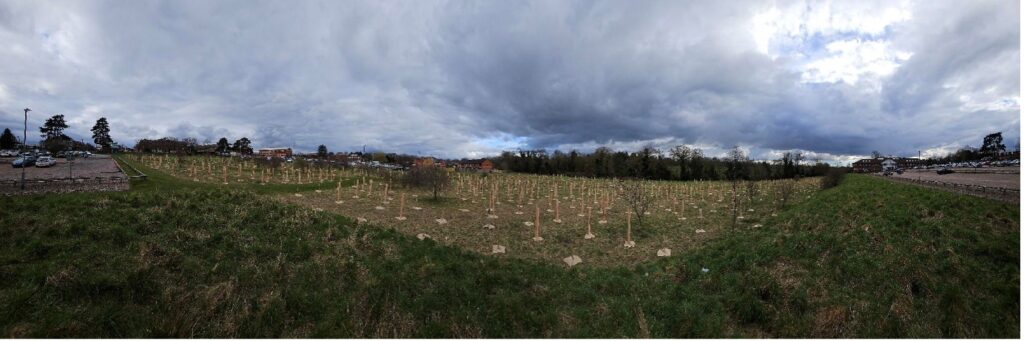
Tree planting is part of University Hospitals of Leicester NHS Trust’s broader sustainability goals, including expanding green spaces, promoting biodiversity and improved wellbeing for site users. NHS Forest worked closely with UHL staff to develop a tailored planting plan aligned with the Trust’s long-term vision for the site and is an excellent example of how NHS Forest is able to work with NHS partners across funding, site design and to engage with the local community while supporting strategic environmental and health outcomes.
Next steps
Ready to apply? You can express your interest in receiving fully funded trees on the NHS Forest website.
If you would like more information about larger-scale tree planting, please get in touch via info@nhsforest.org – or check out our FAQ page for answers to some of the most commonly asked questions about tree planting.