
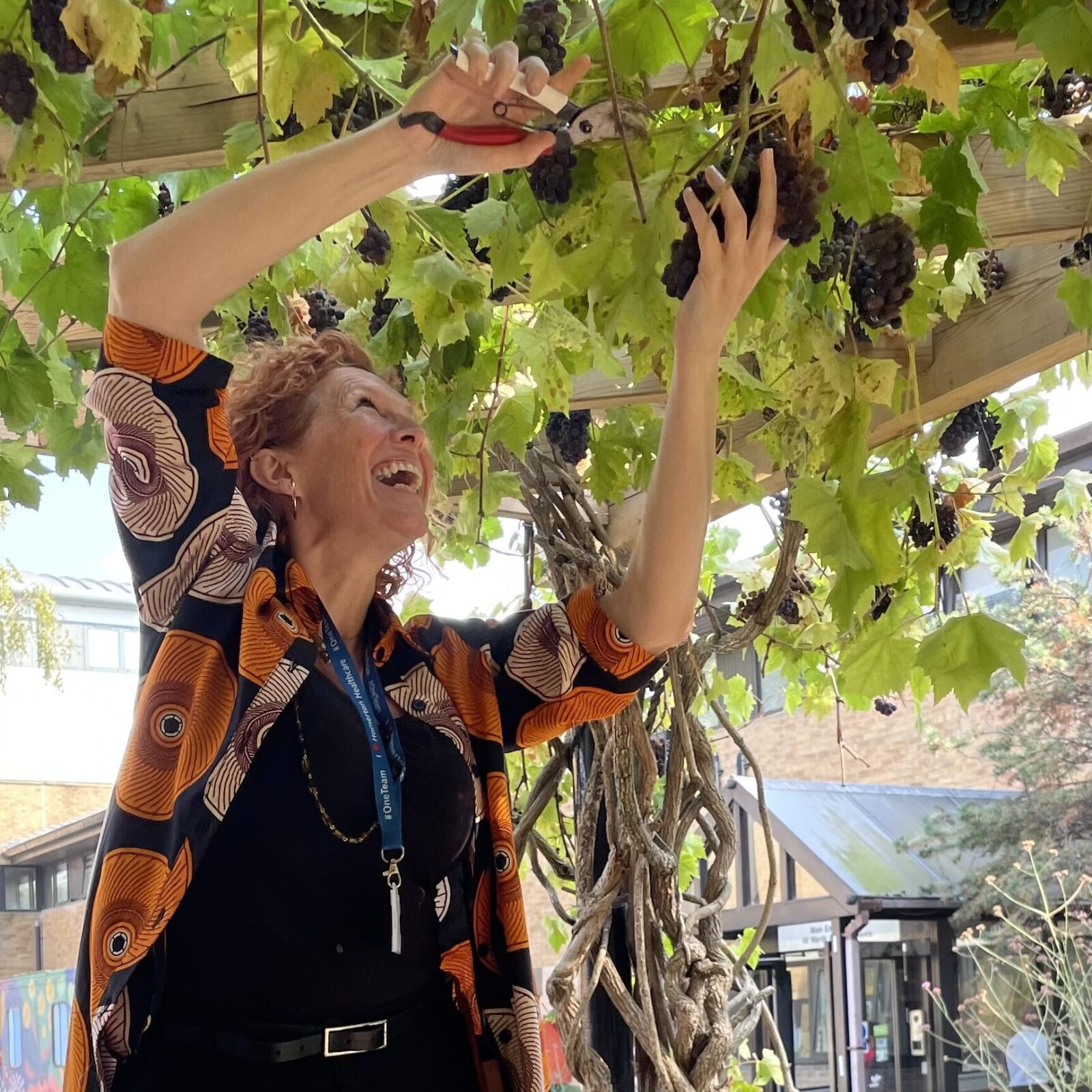
Emma is the Senior Nature Recovery Ranger at Guy’s and St Thomas’ NHS Foundation Trust (GSTT) for the Healthy by Nature project, which is funded by the National Lottery Community Fund.
I trained with the Royal Horticultural Society in 2008 followed by a bachelor’s degree in Occupational Therapy. I then went on to complete a postgraduate diploma in Social and Therapeutic Horticulture with Coventry University, the Royal College of Occupational Therapists and Thrive. I’ve also completed further training in inclusion, community engagement, mental health first aid and nature connection. I worked in the NHS for many years as a highly specialised paediatric occupational therapist. Occupational therapy is incredibly useful foundational training for horticultural therapy and nature connection. Occupational therapy is framed by considering the person, the occupation and the environment – all key aspects of connecting people with nature.
This combination of skills gives people faith in my delivery when they know I’m experienced in nature skills and I’m also an experienced clinician used to delivering in complex healthcare services. This means I can deliver a provision that is the best fit for the service and meets the needs of patients, visitors and staff in that unique environment.
Before joining Healthy by Nature, I spent two and a half years as the Horticultural Therapist at Homerton Healthcare NHS Foundation Trust, contributing to the trust’s Green Plan. I am also an investigator on a research project funded by the Stroke Association, exploring how green spaces can support recovery in stroke patients. As an evidence-based practitioner, I am really motivated to do more research, actively looking for those opportunities. I’m part of APRIN Network where I bring my knowledge and learning back to my team at CSH so we’re working with science/research-backed approaches
My particular area of interest is food growing, because of all the ways food growing skills can tackle obesity, diabetes, stroke and so many preventable conditions. Plus, harvesting and eating food you’ve been part of growing is really delicious and fun! I’ve taken specialist training in food forests, studying with Martin Crawford, the UK’s leading expert, and completing a year-long course with the Orchard Project. I live in the beautifully diverse city of London and use global crops to represent that rich diversity in the plants we grow. Food forests have taught me about world foods I can grow in an allotment garden at a hospital in London. For me, that’s inclusion in action. I’m not just talking about being inclusive by building a wheelchair-accessible raised bed. I’m building that raised bed, but I’m also planting the things that people from Jamaica, Trinidad, Thailand and Russia might recognise from their own communities. This links to my clinical focus, which is person-centred practice and inclusion.
My role at GSTT is hugely varied. It spans five major hospitals: St Thomas’, Guy’s, Evelina London Children’s Hospital, Royal Brompton and Harefield, as well as numerous community sites. I’m working with sustainability and transformational change partners to embed quality interventions that meet our patients where they are, and it’s a privilege to be part of the nationally recognised provision at Harefield and Royal Brompton supporting patients and their families on their heart and lung transplant journeys.
The job is often like a puzzle. Apart from Harefield, which feels like the ‘country estate’ of the trust, with lakes, herons and beehives, the other hospitals are very urban. Guy’s has indoor atriums but no gardens. Evelina London has a balcony about the size of my lounge, to meet the needs of hundreds of children and their families, while Brompton has one tiny garden for staff, some lovely outdoor atriums for patients and their families, but no purpose-built beautiful garden to relax in. So, how do you do nature connection when you don’t have any garden space? For me the answer lies in thinking about our hospitals as anchor institutions: integrating our community into our sites. At St Thomas’ we have the incredible resource of Archbishop’s Park just behind us, two potential allotment growing sites nearby and community growing connections through Lambeth Council. It’s really about partnerships, big and small. If I can crack this, the model will apply to so many urban sites and maybe answer the question of how we turn the urban into a jungle. How do we make the concrete green?
I have a few favourite spots, but you can’t beat sitting beside the Thames at St Thomas’. There’s the Florence Nightingale Garden and a wildflower meadow right on the river, and you can sit in the café and look across them, over the Thames, to the Houses of Parliament. The river is the capital’s lifeblood, its artery, and I get to work beside it. I’m a green space person, so thinking about how to connect people to blue space is a new challenge for me, which I’m excited about.
There is so much to look forward to over the coming seasons. This winter we’re planting trees at Harefield. We’re growing a forest, basically, and that’s going to be an incredible biodiversity space that will create an even more fabulous environment for the patient on short and very-long stay care. We’re exploring whether we can build food growing beds outside the school at Evelina London, working with our Infection Prevention Control colleagues, so that children can learn about where their food comes from as part of their formal education, whilst they are in hospital, as well as their social education. At Guy’s we want to do some planting in the staff wellbeing area. I would love us to be growing chillies, aubergines and wonderful plants from the tropics in the atriums because it’s certainly hot enough in there for some crops that need heat. I’m also looking forward to connecting with our community sites to see what the amazing practitioners are doing there for biodiversity and food growing, and to build a lovely piece of joint working with the dietitians, thinking about our food system from the garden on one side and clinical education on healthy food lifestyles on the other.
People ask how one ranger can work across a trust of this size. The answer is a three-stranded approach: Specialist, Targeted and Universal. The thread running through it all is building nature connection tools that work independently so we can reach more people. Tools that, as my mum would say, are wheels that turn on their own.
There’s history on the sites too. I recently visited the Old Operating Theatre Museum and Herb Garret, part of the original St Thomas’ Hospital near London Bridge. The original hospital had a monastic herb garden. The monks who grew healing herbs gave way to the herb women, the herb women became apothecaries and the apothecaries became pharmacists. I’d really love somewhere at St Thomas’ to try and recreate a part of that garden because it connects to the history of this ancient hospital and speaks of the ethos of Nye Bevan and the NHS, supporting the health of anyone who walks through her doors.
There are lots of ways for communities and volunteers to get involved. One of our ideas is to put raised beds along the Thames side at St Thomas’, and there will be labour days when we need all hands on deck for shovelling soil and getting plants in the beds. When our gardens go in, we’d welcome donations of plants and seeds, and I would love to start a seed bank and run seed swaps. I’d love to hear from someone with knowledge of the history of our hospitals and their gardens as well. Of course, help with fundraising is always welcome too!
To get in touch with Emma, email info@nhsforest.org