

By Duika Burges Watson, CSH Nature Recovery Ranger at Newcastle Hospitals NHS Foundation Trust
The pond was crystal clear. Not because anyone had cleaned it, but because water fleas had done what water fleas do – filtering, feeding, quietly making the world habitable. Dr Mike Jeffries crouched at the edge and pointed to dragonfly larvae just visible beneath the surface. Broad bodied chaser dragonflies, scarce this far north, he told us, with the pleasure of a man delivering excellent news. They are coming. The evidence is already in the water, if you know how to look.
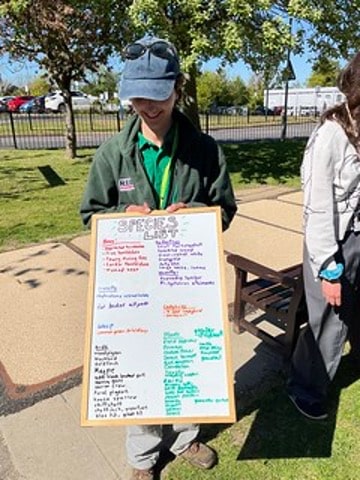
Members of the Natural History Society of Northumbria and Mike had come to Freeman Hospital with nets and species sheets for our Big Hospital Wildlife Count. In a single grassland survey near the labyrinth, they recorded fourteen species of bird, six of butterfly, five of bee. The list of animals from the pond was an increase from last year – species counts that speak to the slow, steady improvement of the habitat. Our own staff once described the pond as “not very inviting”, but we now know it has a Big Pond Dip score of 42, based on the bugs we found, which is in the “brilliant” range.
And then there are the underground networks we know so little about.
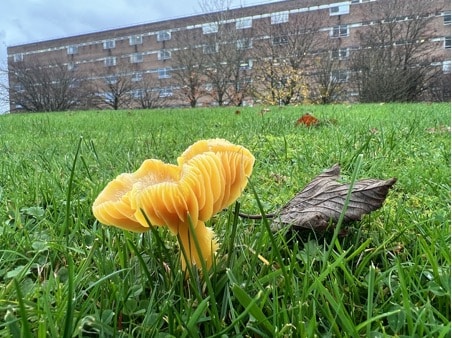
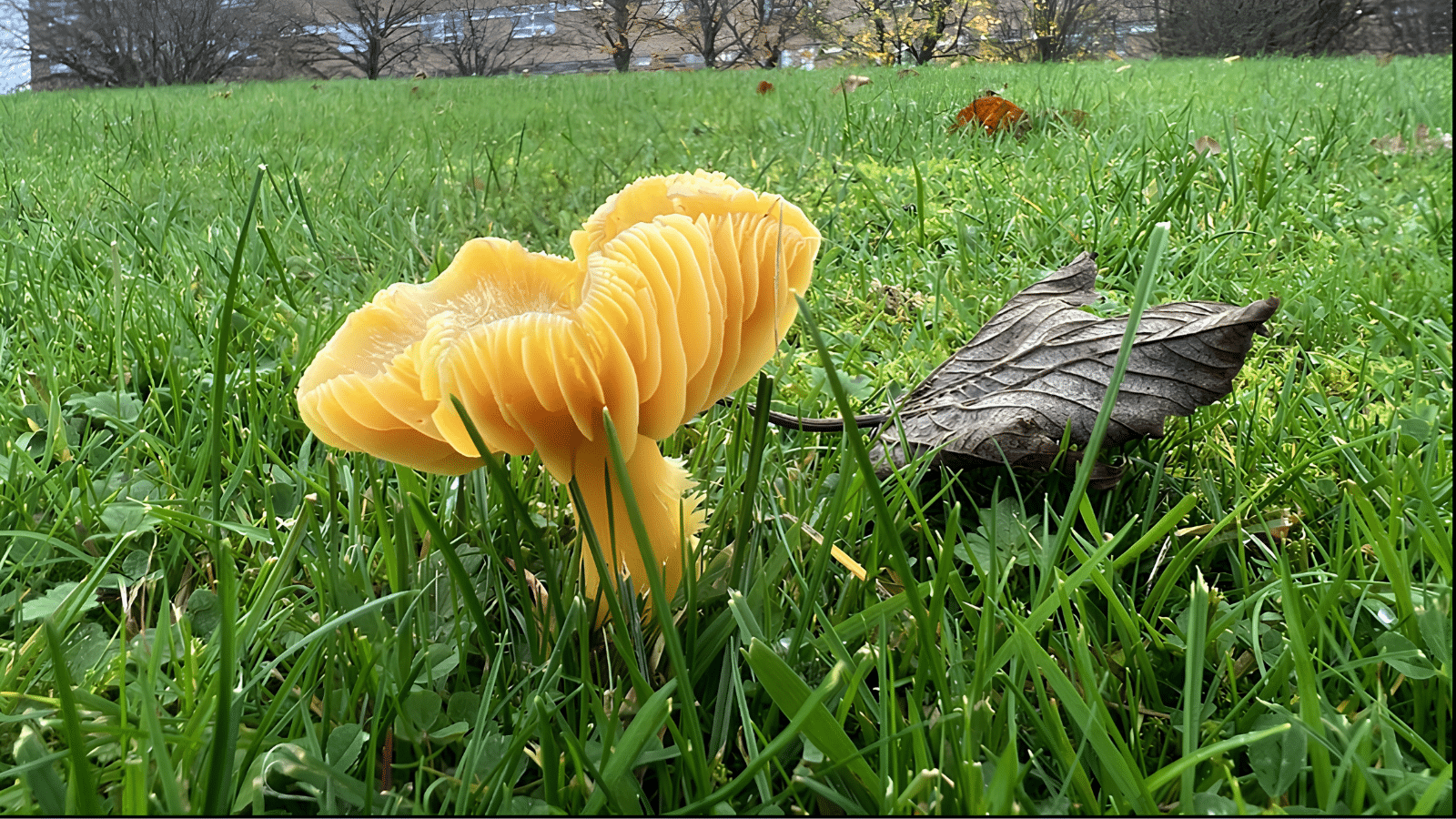
Last October, tucked into the grassland, I photographed an oily waxcap – Hygrocybe quieta, IUCN vulnerable. Waxcaps are indicators of grassland that has never been ploughed, fertilised, or disrupted. Their underground mycelium grows slowly across decades, unable to re-establish for centuries once lost. More than 97% of species-rich grasslands in the UK have disappeared since the 1930s (Plantlife, 2022). The sites that survive tend to be old churchyards, ancient lawns, estate parkland – and, it turns out, a hospital estate in Newcastle upon Tyne that has been quietly mown, rather than improved, for long enough to hold something rare. The waxcap was not planted. It survived because that corner was left alone.
Through the day, something close to eighty people passed through the labyrinth and the wildlife stall – nurses, estates teams, clinical staff, stopping on their way somewhere else. Twenty-five children from Free Spirit Nursery were the first to look at the pond, with five members of staff and the focused intensity children bring to anything involving the possibility of creatures. Around thirty patients and clinicians made their way to the pond too. And a child from the cardiothoracic ward, her dad carefully wheeling her Berlin heart, mum holding hands. She carefully swished the net through the water, catching dragonfly nymphs and baby water boatmen. We were told it was the first childhood moment she had experienced since her admission, seven months ago.
I am still sitting with that.
We are often asked how we engage the community – as if community is somewhere else, needing to be brought in, invited, persuaded. Watching the day unfold, I thought: the community is already here. Every part of it. Nursery children and cardiothoracic patients. Haemodialysis nurses and naturalists. A hospital is an anchor institution. It doesn’t draw a community – it is one, arriving continuously, in need. The nature is already here too. The water fleas were there before we looked. The waxcap was fruiting before we found it. The dragonfly larvae were in the water before Mike named them.
Standing in that landscape, I found myself thinking about Lord Armstrong, whose legacy is part of why any of this exists. The Ouseburn runs south from here through Jesmond Dene, which Armstrong gave to the people of Newcastle in 1883 – a remarkable public health act before we had language for such a thing. The wildlife corridor connecting Freeman to Jesmond Dene and Gosforth Park runs through land his generosity helped shape. But Armstrong’s relationship with nature, as Henrietta Heald’s biography makes clear, was one of mastery – he curated, arranged, and bestowed. Nature as something to be shaped for human benefit by those with the power and money to do so. It is a habit of mind we have inherited along with the green spaces themselves.
Biodiversity is a policy commitment, and real work has gone into delivering it here – meadows seeded, habitats created. But finding the waxcap made me think hard about what we mean by creating nature. It was there because nothing had disturbed it. Its presence is changing how I think about the direction of this work – less about what we make, more about what we might be standing on without knowing it.
Which is what makes me question my own title. As the first NHS trust to declare a climate emergency, we have committed to understanding our relationship with the natural world differently. Our draft Green Spaces and Health Plan is built on that premise: that green space is clinical infrastructure, not amenity. But I think recovery, as a word, can still carry the old assumption – that nature is out there, waiting to be fixed. What if the more important shift is recognising that we are already inside it? Staff, patients, clinicians, estates teams – not managers of this living system, but part of it.
The dragonflies were coming whether we looked or not. The grassland is older than anyone knew. The question is whether we are willing to notice that we are already inside something living, and let that change how we act.
With thanks to Ellie Davison and her team at the Natural History Society of Northumbria, and to Dr Mike Jeffries, for bringing their expertise and enthusiasm to the day. And to Rebecca Giles, Karen Taylor, and Carmel Abbott, and the many staff, patients, and volunteers who came out and made it what it was.
References
Heald, H. (2010) William Armstrong: Magician of the North. McNidder & Grace.
Plantlife (2022) The State of the UK’s Wildflower Meadows. plantlife.org.uk